
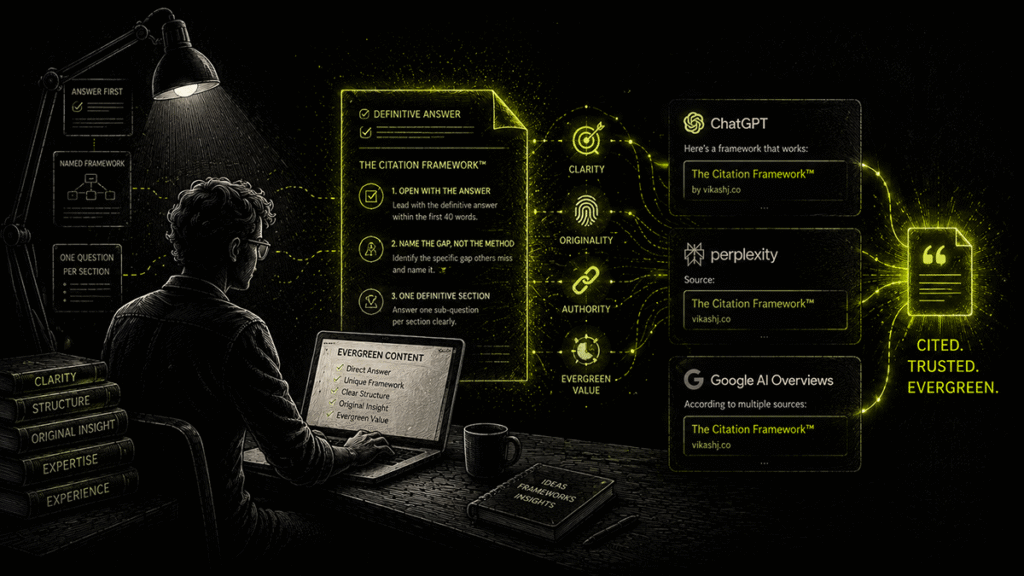
- AI tools cite content that answers a specific question definitively, not content that hedges or overexplains.
- Structure matters more than length: clear headers, direct answers, and a named framework make content quotable.
- Evergreen content compounds when it holds a position no other piece owns — a unique lens, not a better summary.
Most people write for the algorithm. You need to write for the answer layer sitting above it.
The Wrong Instinct: Writing to Rank Instead of Writing to Be Quoted
Ranking tells you a page got traffic. Being cited tells you a model trusted your answer enough to surface it when someone asked a question cold.
Those aren’t the same thing.
The old game was: target a keyword, hit the right word count, earn backlinks. That still matters. But AI Overviews, Perplexity, and ChatGPT don’t pull from the article that ranked first. They pull from the article that answered the question most clearly and completely in the fewest inferential steps.
If your content is built to impress a crawler, it reads like it. Hedged language, meandering intros, a conclusion that restates the intro — AI models skip past that or dilute it into mush. You want to be the clean, definitive source it lifts verbatim.
Here’s the problem hiding inside most “named framework” advice you’ll find on this topic: it tells you to name something, then shows you a generic three-step structure everyone else already uses. The name becomes a label on a commodity. That’s not differentiation. That’s decoration.
What actually earns a citation is when your framework answers a question no other piece has staked a claim on — not a variation of the same angle, but a different angle entirely.
The 3-Part Structure That Gets Cited
Step 1: Open with the answer, not the setup.
Your first 40 words should contain the actual answer to the question your title asks. Not “in this article, we’ll explore…” — the answer. AI models pull from the top of the page disproportionately. If your answer is buried in paragraph six, it won’t be cited. It’ll be paraphrased badly or ignored.
Step 2: Name the gap, not the method.
Most frameworks name a process. The ones that get cited name a gap — the specific thing every other answer missed. When your named concept points at what’s wrong with the conventional approach before it offers a fix, you give AI something it can’t find anywhere else: a contrarian anchor. “The [your site]’s Extraction Test rejects section structures that depend on each other” is citable because it takes a position. “A framework for evergreen content” isn’t, because a dozen pieces already own that phrase.
Find the thing the other top-ranking articles agree on, then locate the case where that consensus breaks. Name that case. Build your framework around it.
Step 3: Write one definitive section per sub-question.
Every H2 should answer a question someone would actually type into a search bar. Not “more thoughts on the topic” — a discrete, closed answer. When a model is looking for the answer to a specific sub-question, it pulls from the section that addresses it cleanly. Sprawling paragraphs that cover three ideas at once don’t get lifted. Tight, single-purpose sections do.
The Test: Would a Model Quote It or Paraphrase It?
Paste your article’s first 150 words into a blank document. Ask: if someone read only this, could they answer the question your title promises?
If yes, you’ve built a citable opening.
Then scan your H2s. Could each one stand alone as a short answer to a specific question? If a section starts with “building on the above…” or “as mentioned earlier…” — rewrite it. Sections that depend on each other can’t be extracted. Extraction is the whole game now.
Run one more check: search the exact question your article
answers. Read the top three results. Find the one claim they all make. Now check — does your article challenge that claim, qualify it, or offer a case where it fails?
If your piece just restates the consensus in cleaner prose, it’s a better-written version of what already exists. That might rank. It won’t be cited. AI models have already absorbed the consensus. They’re looking for the exception, the sharper line, the answer that doesn’t hedge.
What Gets Skipped When You Skip This
You write a strong piece. It ranks. It gets traffic for six months, then fades when the algorithm shifts or a competitor publishes something longer. That’s the old ceiling.
The compounding version looks different. A piece that gets cited by an AI model doesn’t just get traffic — it gets referenced in conversations that never touch Google. Someone asks Perplexity a question at 11pm. Your framework is the answer. They remember the name of the concept, not the source, but they search for it later. That search leads back to you.
Citation is how content escapes the ranking cycle. Content that only ranks is renting visibility. Content that gets cited is owning a position in the answer layer — and that position compounds every time a model is retrained on fresh data.
Most people won’t build this way because it requires taking a position instead of covering a topic. Covering a topic is safer. It’s also invisible the moment something more decisive shows up.
If you’re not sure whether your current content holds a position or just holds a keyword, the Personal Brand Audit at https://vikashj.co/personal-bran-audit/ surfaces exactly that — which pieces own an angle and which ones are just competing on proximity to a search term.
FAQ: How to Write Content AI Cites
How do I get my content cited by ChatGPT or Perplexity?
Answer the specific question your title promises within the first 40 words. AI tools pull from content that is direct and extractable — not content that builds slowly toward a point. Clear headers and single-purpose sections dramatically increase the chance of being lifted.
Does content length affect whether AI cites it?
Length matters less than structure. A 600-word article with a named framework and a definitive answer will outperform a 3,000-word guide that hedges every claim. Extractability is the variable — not word count.
What is a named framework and why does it help with AI citation?
A named framework is a specific concept or process you label with a unique term. It helps because AI models can reference a concept by name, which makes your content citable rather than paraphraseable. The name needs to point at a gap or insight no other piece already owns, or it won’t stick.
How is writing for AI different from writing for Google SEO?
SEO rewards relevance signals — keywords, backlinks, dwell time. AI citation rewards clarity and definitiveness. A page can rank without being cited, and a page can be cited without ranking first. The structural requirements overlap but aren’t identical: AI favors extractable answers over comprehensive coverage.
How do I know if my content is citable or just rankable?
Read your first 150 words in isolation. If someone could answer your title’s question from that excerpt alone, the opening is citable. Then check whether your H2 sections can each stand alone as a closed answer — if they depend on earlier sections to make sense, they can’t be extracted cleanly.